

Treatment led by Dr. Mahrokh Fotooei, Specialist Dermatologist, in Al Sadd — with peel strength and laser depth chosen for your skin tone, not applied from a standard menu.
Acne is not only a teenage problem, and it is not caused by poor hygiene. But daily life here does add pressure that patients elsewhere do not face.
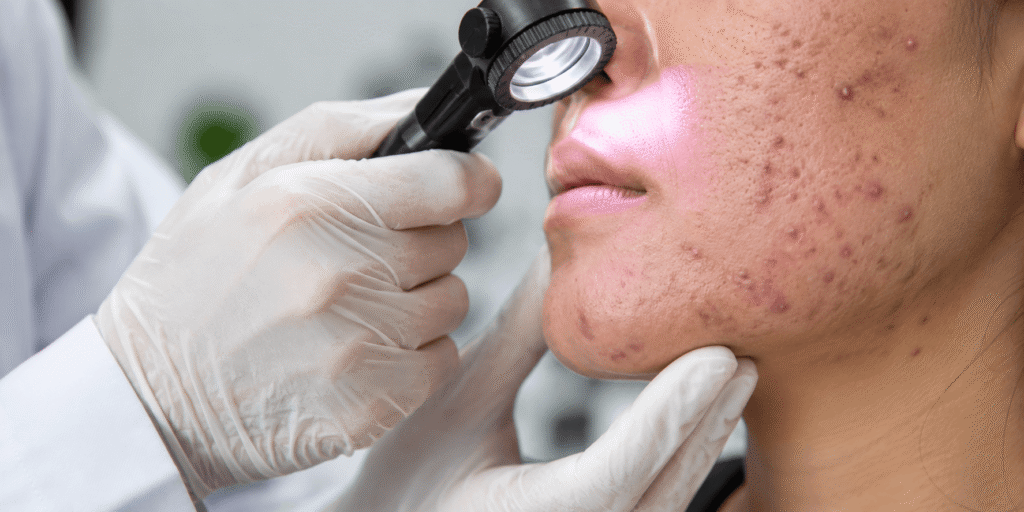
Months of high humidity mean sweat sits on the skin far longer. Combined with sunscreen, make-up or work dust, pores stay blocked for longer than they otherwise would.
Helmets, face masks, tight collars, sports gear and headscarves all create constant rubbing against the skin. This produces a specific pattern of breakouts along the jawline, forehead and hairline.
Air conditioning dries the skin, which people answer with harsher cleansers and scrubbing. Stripped skin produces more oil, not less — one of the most common self-inflicted causes we see.
Clearing the acne comes first. Treating scars while spots are still forming means treating a surface that is about to change again — and some scar treatments cannot be used at all while acne medication is in your system.
| Type | What it looks like | General approach |
|---|---|---|
| Comedonal | Blackheads and whiteheads, little redness or swelling | Topical retinoids and pore-clearing treatment; often the simplest to resolve |
| Inflammatory | Red, swollen, tender spots | Topical and sometimes oral treatment to reduce bacteria and inflammation |
| Nodulocystic | Deep, painful lumps under the skin that last weeks | Needs prescription treatment early — this is the type most likely to scar |
| Hormonal | Jawline, chin and neck; flares with the menstrual cycle | Investigation of the hormonal driver alongside skin treatment |
Most patients who come to us for “acne scars” do not have scars. They have marks. The two look similar in a mirror and are completely different underneath — and treating one as though it were the other wastes money and, on darker skin, can make things worse.
There is a simple test you can do right now. Close your eyes and run a fingertip lightly over the area. If the skin feels smooth and flat, you have marks. If you can feel dips, pits or raised areas, you have textural scarring. Many people have both.
Flat marks
Pigment and redness left behind
True scars
Why this matters most on darker skin. Deep peels and aggressive laser resurfacing carry a real risk of triggering more pigmentation on Fitzpatrick IV–VI skin — the exact problem many patients arrive trying to fix. If your concern is flat brown marks, the honest answer is usually a gentler, cheaper course of treatment plus daily sunscreen, not resurfacing. We will tell you that even when it means a smaller treatment plan.
There is no single best treatment for acne scarring. The right approach depends on what you have, and most patients with mixed scarring need a combination rather than one procedure repeated.
| What you have | Usual approach | What to expect |
|---|---|---|
| Brown marks (PIH) | Topical pigment treatment, gentle chemical peels, daily SPF 50 | Gradual fading over several months; sun protection does most of the work |
| Red marks (PIE) | Time, barrier repair, and vascular-targeted treatment where needed | Usually settles on its own; treatment shortens the timeline rather than replacing it |
| Rolling scars | Subcision to release the tethering, often with microneedling or collagen stimulation | Several sessions; releasing the tether is what changes the contour |
| Boxcar scars | Fractional laser resurfacing or microneedling to soften the edges | Improvement rather than erasure; typically 3–6 sessions |
| Ice pick scars | Focused techniques such as TCA CROSS rather than general resurfacing | The most stubborn type; realistic goal is reduced visibility |
| Raised or keloid scars | Steroid injection and flattening protocols | Needs a different approach entirely — resurfacing can worsen these |
An honest word on results. No treatment removes acne scars completely. Good treatment makes them substantially less visible, and combination treatment over time does more than any single procedure. Anyone promising complete removal is overselling.
The question we get asked quietly
For severe, scarring or persistent acne that has not responded to other treatment, isotretinoin remains the most effective option in dermatology. It is also the most misunderstood, and most of what patients have read about it online comes from forums rather than clinicians.
It is a serious prescription medication. It requires proper assessment, blood monitoring during treatment, and strict precautions for anyone who could become pregnant, because it causes severe birth defects. It is not something to obtain from a pharmacy abroad or from someone else’s prescription.
One point almost nobody mentions: laser resurfacing and deep chemical peels are generally avoided during isotretinoin treatment and for a period afterwards, because the skin heals differently. This is exactly why your acne and your scarring need to be planned together, in the right order, by the same doctor.
If you are already taking it, or have taken it recently, tell us at your consultation. It changes what we can safely do and when.
What to expect
Why Al Kindi
Specialist Dermatologist with 15 years of experience. Your skin is examined and diagnosed by a doctor before any treatment is proposed — not assessed at a reception desk.
Peel strength and laser depth are chosen for your Fitzpatrick skin type, because the settings that suit lighter skin can trigger pigmentation on richer tones.
We tell you whether you have marks or scars, and we say so plainly when the honest answer means a smaller treatment plan than you expected.
Street 808, Zone 39, Building 73 — central, easy to reach, and open until 9 pm every day.
Dark marks are pigment left behind after a spot heals. The skin surface is flat and smooth, and these fade on their own over months to a couple of years. True scars are a change in the skin’s structure — pitted, indented or raised — and they do not fade without treatment.
Run a fingertip over the area with your eyes closed. Smooth means marks. Uneven means scarring. Many people have both, which is why diagnosis matters before anyone recommends a treatment
There isn’t one. The best treatment depends on which type of acne you have. Blackheads and whiteheads respond to topical retinoids and pore-clearing treatment. Red inflamed spots usually need something targeting bacteria and inflammation. Deep painful lumps need prescription treatment early, because that is the type that scars. Hormonal acne along the jawline needs the hormonal driver investigated, not just the skin treated.
Anyone recommending a treatment before examining your skin is guessing. That is why the consultation comes first and the treatment plan comes second.
Honestly, you can’t clear acne in days — and treatments that promise it usually strip the skin, which makes oil production worse. Give any proper treatment 8 to 12 weeks to judge.
There is one genuine exception. A single large, painful cyst can be settled with a steroid injection, which usually flattens it within a day or two. That is useful before a wedding or an interview. It treats that one spot, not the acne itself.
The fastest real route is getting the diagnosis right the first time. Most patients who take years to clear have spent that time cycling through products aimed at the wrong type of acne.
It depends entirely on which scars you have. Rolling scars respond best to subcision, which releases the tethering underneath. Boxcar scars respond to fractional resurfacing or microneedling. Ice pick scars need a focused technique such as TCA CROSS rather than general resurfacing. Raised or keloid scars need steroid injection — resurfacing can make those worse.
Most people have more than one type, which is why combination treatment planned over time outperforms any single procedure repeated. And if what you have is flat dark marks rather than scars, the best treatment is a gentler and much cheaper one.
No treatment removes acne scars entirely. Good treatment makes them substantially less visible, and a combination of approaches over time achieves more than any single procedure repeated. Any clinic promising complete removal is overselling. Flat dark marks are a different matter — those genuinely can clear completely.
Expect 8 to 12 weeks to judge whether a treatment is working. Skin can look worse in the first few weeks as deeper blockages surface, which is normal and not a reason to stop. Anything promising clear skin in days is not treating the cause.
True scars cannot be treated quickly. Every effective method works by prompting the skin to rebuild collagen, and collagen takes months to form — so a course of three to six sessions spread over several months is the realistic timeline, with improvement continuing for months after the final session.
Flat dark marks are the faster case. Those respond to pigment treatment and strict daily sunscreen, and many patients see a clear difference within a few months. If speed matters to you, the most useful thing is finding out which of the two you actually have — because half the people asking this question are treating the slower problem when they have the faster one.
For diagnosis, yes. Deciding whether you have marks or scars, and which type of scar, determines the entire treatment plan — and getting it wrong wastes money at best and worsens pigmentation at worst. That assessment is a medical one.
It also matters for safety. Peel strength and laser depth carry real risk on richer skin tones, and procedures like subcision and steroid injection are medical treatments regardless of where they are offered. At Al Kindi you are examined and diagnosed by Dr. Fotooei before any treatment is proposed.
It can, if the strength is wrong for your skin tone. On Fitzpatrick IV–VI skin, peels that are too aggressive can trigger post-inflammatory hyperpigmentation — the exact problem many patients are trying to treat. This is why the peel is selected after your skin type is assessed, and why we often start gentler and build up.
Generally no. Laser resurfacing and deep peels are usually avoided during isotretinoin treatment and for a period afterwards, because the skin heals differently. Tell us at your consultation if you are taking it or have taken it recently — it changes what we can safely do and when.
Typically three to six sessions spaced four to six weeks apart, depending on scar type and depth. Rolling scars usually respond faster than boxcar scars, and ice pick scars often need a different technique altogether. You will be given an expected number at your consultation rather than an open-ended course.
Diet is not the cause, but it can be a contributor for some people. The evidence is strongest for high-sugar foods and, in some studies, dairy. It is worth looking at if your acne is otherwise unexplained — it is not worth cutting out food groups before your skin has been properly assessed.
Usually because treatment stopped once the skin cleared. Acne is a long-term condition rather than an infection that is cured, and most people need some form of maintenance treatment to hold the result. Recurrence can also mean an underlying driver — hormonal, in many adult cases — that has not been addressed.
There is no single best treatment, because the right one depends on which type of acne you have. Blackheads and whiteheads usually respond to topical retinoids. Red inflamed spots often need treatment aimed at bacteria and inflammation. Deep painful nodules generally need prescription medication early, before they scar. Hormonal acne along the jawline needs the hormonal driver addressed, not just the skin.
Any clinic recommending the same treatment to every acne patient is selling a service rather than treating a condition. Diagnosis comes first.
Honestly, you cannot. Skin cells turn over on a fixed cycle, and no treatment shortens that. Expect 8 to 12 weeks to judge whether a course is working, with skin sometimes looking worse in the first few weeks as deeper blockages surface.
What you can do quickly is stop making it worse: do not pick or squeeze, because that is what turns a spot that would have healed cleanly into a mark or a scar. Stop scrubbing and switching products every week. Wear sunscreen daily, since sun exposure darkens every mark acne leaves behind. A single inflamed lump before an event can sometimes be settled with a steroid injection, but that treats one spot, not acne.
It depends entirely on which type of scar you have, which is why the comparison table above matters more than any single recommendation. Rolling scars usually need subcision to release the tethering underneath. Boxcar scars respond to fractional resurfacing or microneedling. Ice pick scars need focused techniques such as TCA CROSS rather than general resurfacing. Raised and keloid scars need a different approach again — resurfacing can make them worse.
Most patients have more than one type, so the best result usually comes from combining treatments over time rather than repeating one procedure.
Textural scars cannot be removed quickly. Treatment works by stimulating your own collagen to remodel, and that takes months regardless of the technique used — most courses run three to six sessions spaced four to six weeks apart, with improvement continuing after the final session.
If what you have is flat dark marks rather than true scars, the timeline is different and much more encouraging. Those fade on their own, and consistent sun protection plus pigment-focused treatment speeds it up considerably. This is the single most common reason patients are quoted for expensive resurfacing they do not need — so find out which one you have first.
The improvement is permanent, in the sense that remodelled collagen does not undo itself. Treated scars do not return.
What is not permanent is protection against new scarring. If your acne is still active, new spots can leave new scars, which is why we control the acne before treating the scars. Flat dark marks are also permanent once cleared — provided you use sun protection, because sun exposure is what brings pigmentation back.
Yes, and ideally before you buy any treatment. The reason is diagnostic rather than promotional: telling flat marks apart from textural scars, and identifying which type of scar you have, determines whether the right answer is a gentle course of peels, a resurfacing plan, subcision, or simply time and sunscreen. Those options differ enormously in cost and in risk.
It also matters for skin tone. Treatments that are routine on lighter skin can trigger pigmentation on Fitzpatrick IV–VI skin, and judging that safely needs a dermatologist rather than a treatment menu.

Specialist Dermatologist · MBBS, MD (Dermatology).
QCHP licensed. 15 years' experience
Dr. Mahrokh Fotooei treats skin at Al Kindi Clinics Center in Doha, with a focused practice in injectable aesthetics, non-surgical facelifting and laser skin rejuvenation.
Patients consistently describe her as someone who explains each step before it happens — which matters more than it sounds when you are deciding whether to have a procedure at all.