A root canal removes the infected nerve from inside a tooth, cleans it and seals it, so you can keep your own tooth. At Al Kindi Clinics Center in Al Sadd, our dental team plans every root canal with digital X-rays and uses rotary files and a rubber dam to keep the tooth clean.
| What it is | Treatment inside the tooth to remove an infected or inflamed nerve and save the tooth |
| Who treats you | Our dental team at Al Kindi Clinics Center |
| Technology | Digital X-ray, OPG and 3D CBCT scans, rotary NiTi files, rubber dam |
| Comfort | The area is numbed before treatment starts |
| After treatment | A filling or a crown, chosen for your tooth |
| Also available | Root canal re-treatment, nerve treatment for children, same-day toothache care |
| Insurance | Al Koot and QLM accepted; cover depends on your plan |
| Where | Building 73, Street 808, Zone 39, Al Sadd, Doha. Free parking |
A root canal (also called endodontic treatment or nerve treatment) saves a tooth when the soft inside part, the pulp, becomes infected or inflamed. The pulp holds the tooth’s nerves and blood vessels. It runs from the top of the tooth down through small channels in the roots, called root canals.
When deep decay, a crack or an injury lets germs reach the pulp, it becomes painful and can lead to an abscess. In a root canal, the dentist removes the damaged pulp, cleans and shapes the canals, then fills and seals them. Your tooth stays in place and keeps working.
How a root canal works
Scroll down to follow the six steps, from the infected tooth to the final crown.
Deep decay lets germs reach the pulp. The nerve becomes infected and painful.
After numbing, the dentist removes the decay and makes a small opening to reach the pulp.
The infected pulp is removed and each canal is cleaned and shaped with fine files.
The clean canals are filled with a rubber-like material that seals them to the root tips.
The opening is closed with a filling to keep germs out.
A crown or strong filling protects the tooth, so you can chew and smile as normal.
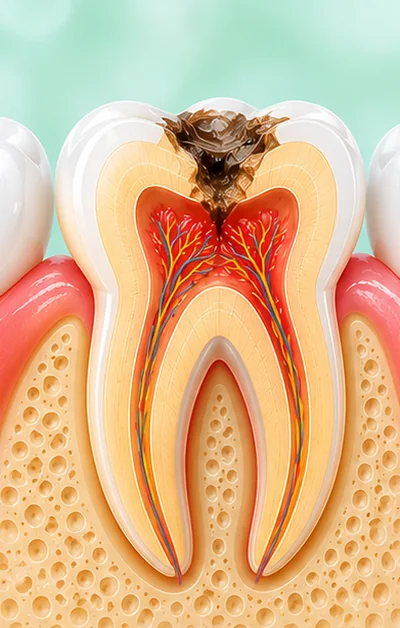
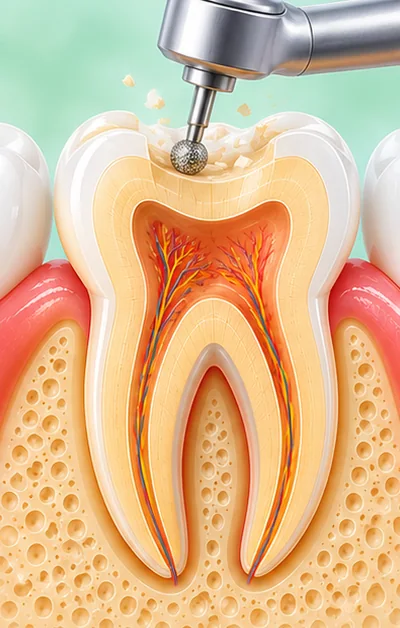
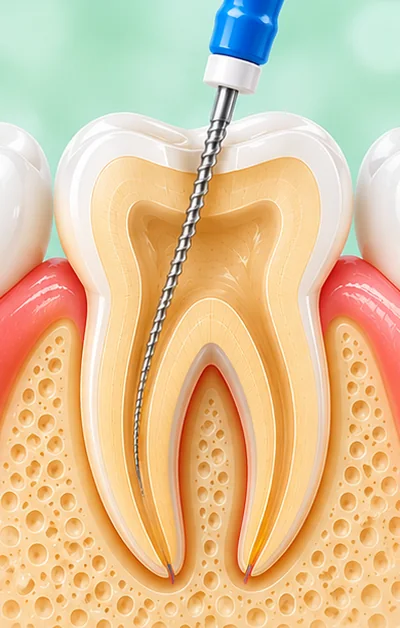
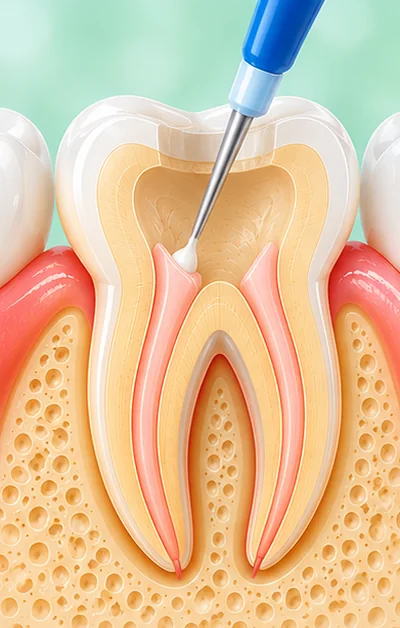
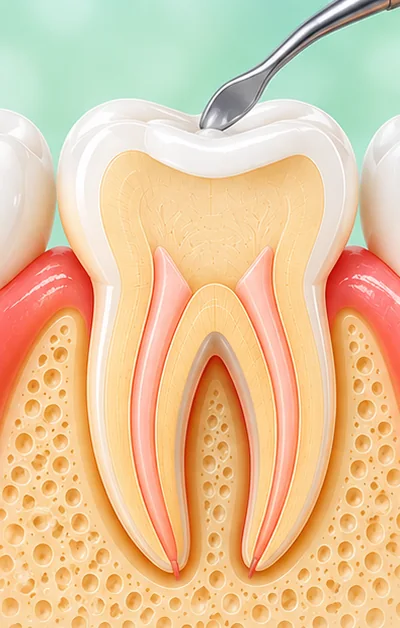
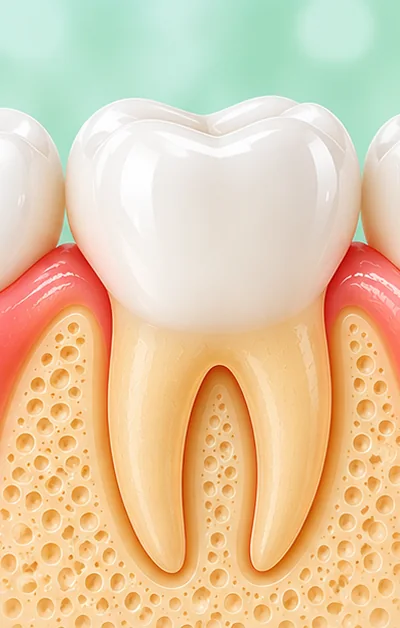 1 · Decay reaches the nerve
These are common signs. Only an examination and an X-ray can confirm if you need a root canal. Sometimes an infected tooth has no pain at all and is found on a routine X-ray.
Strong pain, especially when you chew or bite.
Pain that stays after the drink or food is gone.
Swollen gum or face near the tooth.
A small bump that may leak pus.
The tooth turns darker than the teeth beside it.
Toothache that wakes you from sleep.
The tooth is numbed before treatment, so most people say it feels like having a normal filling. The pain you feel before treatment comes from the infected nerve, and a root canal removes that cause.
After treatment, the tooth can feel sore or tender for a few days. This usually settles with normal pain relief medicine. If the pain gets worse or you notice swelling, contact us.
Root canal treatment at Al Kindi follows the same careful steps for every tooth.
Your dentist examines the tooth and takes a digital X-ray. When needed, an OPG or a 3D CBCT scan shows the roots in more detail.
The area is numbed. A thin rubber sheet, called a rubber dam, keeps the tooth clean and dry.
The dentist removes the damaged pulp and cleans and shapes each canal with flexible rotary NiTi files.
The clean canals are filled with a rubber-like material and sealed to stop germs from coming back.
The tooth is closed with a filling, or covered with a crown when it needs more protection.
When a tooth is badly infected, there are two choices: save it with a root canal, or remove it. Keeping your natural tooth is usually the better choice when it can be saved. If a tooth cannot be saved, we explain your options, including a dental implant.
| Root canal | Extraction | |
|---|---|---|
| Your tooth | Stays in your mouth | Is removed |
| Chewing | Works like a normal tooth | Gap makes chewing harder |
| Other teeth | Stay in place | Nearby teeth can move into the gap |
| Jaw bone | Stays healthy around the root | Bone slowly shrinks where the tooth was |
| Later treatment | Filling or crown | Often an implant, bridge or denture |
After a root canal, the tooth needs a strong final restoration. Your dentist chooses a filling or a crown based on how much tooth is left and where it is.
Back teeth that do heavy chewing, or teeth with large old fillings, often need a crown to protect them from cracking. Read about crowns and bridges.
If an old root canal becomes painful or infected again, the dentist removes the old filling, cleans the canals again and seals them. This can save the tooth a second time.
For baby teeth with deep decay, a pulpotomy removes only the infected top part of the nerve, so the tooth stays until the adult tooth is ready.
A few simple steps help your tooth heal and last.
The cost of a root canal depends on your tooth and what it needs. Your dentist explains the full cost after the examination and X-ray, before treatment starts. See our current special offer below.
The tooth is numbed before treatment, so most people say it feels like a normal filling. The strong pain before treatment comes from the infected nerve. After treatment the tooth may feel sore for a few days, which usually settles with normal pain relief medicine.
Common signs are lasting toothache, pain with hot or cold that stays, swelling, a pimple on the gum or a tooth turning darker. Some infected teeth have no pain. Only an examination and X-ray can confirm it, so book a check if you notice any of these signs.
The infection does not heal by itself. It can spread to the bone around the tooth and cause an abscess, swelling and more pain. In the end the tooth may need to be removed. Treating it early gives you the best chance to save the tooth.
When a tooth can be saved, keeping it is usually better. Your own tooth keeps your bite, chewing and jaw bone healthy. After an extraction, the gap often needs an implant, bridge or denture. Your dentist will tell you if your tooth can be saved.
Not always. Your dentist chooses a filling or a crown based on how much tooth is left and where it is. Back teeth that do heavy chewing, or teeth with large old fillings, often need a crown to protect them from cracking.
Yes, once the numbness wears off. Until your final filling or crown is placed, chew on the other side and avoid very hard or sticky food on the treated tooth. This protects the tooth and the temporary filling.
Some soreness for a few days is normal, because the area around the root needs time to settle. If pain gets stronger after three days, you see swelling, or your bite feels high, contact us so your dentist can check the tooth.
It is a second root canal on a tooth that was treated before but became painful or infected again. The dentist removes the old filling material, cleans the canals again and seals them. This can save the tooth a second time instead of removing it.
Baby teeth with deep decay can have a pulpotomy, a nerve treatment that removes only the infected top part of the nerve. It keeps the baby tooth in place until the adult tooth is ready, which protects space for the adult teeth.
Yes. If you have a strong toothache or swelling, we offer same-day pain relief. Message us on WhatsApp at 7749 7717 and we will find you the earliest time. Severe swelling with trouble breathing or swallowing needs a hospital emergency department.
We use digital X-rays, and OPG or 3D CBCT scans when needed, to see the roots clearly. Canals are cleaned with flexible rotary NiTi files, and a rubber dam keeps the tooth clean and dry during treatment.
The cost depends on which tooth it is, how many canals it has, any infection, re-treatment and the final filling or crown. Your dentist explains the full cost before starting. See the special offer box on this page for our current root canal offer.
We accept Al Koot and QLM insurance. Root canal cover depends on your plan and its limits. Send us your insurance card on WhatsApp and our team will check your cover before your visit.
A tooth with a well-sealed root canal and a strong filling or crown can last many years. Good brushing, flossing and regular dental check-ups help it last. A crack or new decay can still affect it, so look after it like your other teeth.
Al Kindi Clinics Center is in Building 73, Street 808, Zone 39, Al Sadd, Doha, with free parking. We are open Saturday to Thursday 9 am to 9 pm, and Friday 2 pm to 9 pm for dental.
Tell us about your tooth on WhatsApp and we will book you with our dental team. Toothache today? Ask for a same-day visit. Building 73, Street 808, Zone 39, Al Sadd, Doha. Free parking.
Explore more dental treatments